
BlogLettering
Labeling of competition vehicles: from the workshop to the Dakar
10 March 202610 min read
Sports lettering: much more than aesthetics
Racing vehicle lettering is a discipline that combines graphic design, materials engineering and knowledge of the motor world. Unlike conventional commercial signage, sports wrapping must meet extreme requirements: resistance to sand, mud, temperatures exceeding 50°C, constant vibrations and pressure washing after each stage.
In competitions like the Dakar Rally, vehicles are the teams' main advertising platform. Every square centimeter of the body has a commercial and communicative value. Therefore, the design must harmoniously integrate the team's identity, sponsor logos and regulatory elements such as numbers, flags and safety codes.
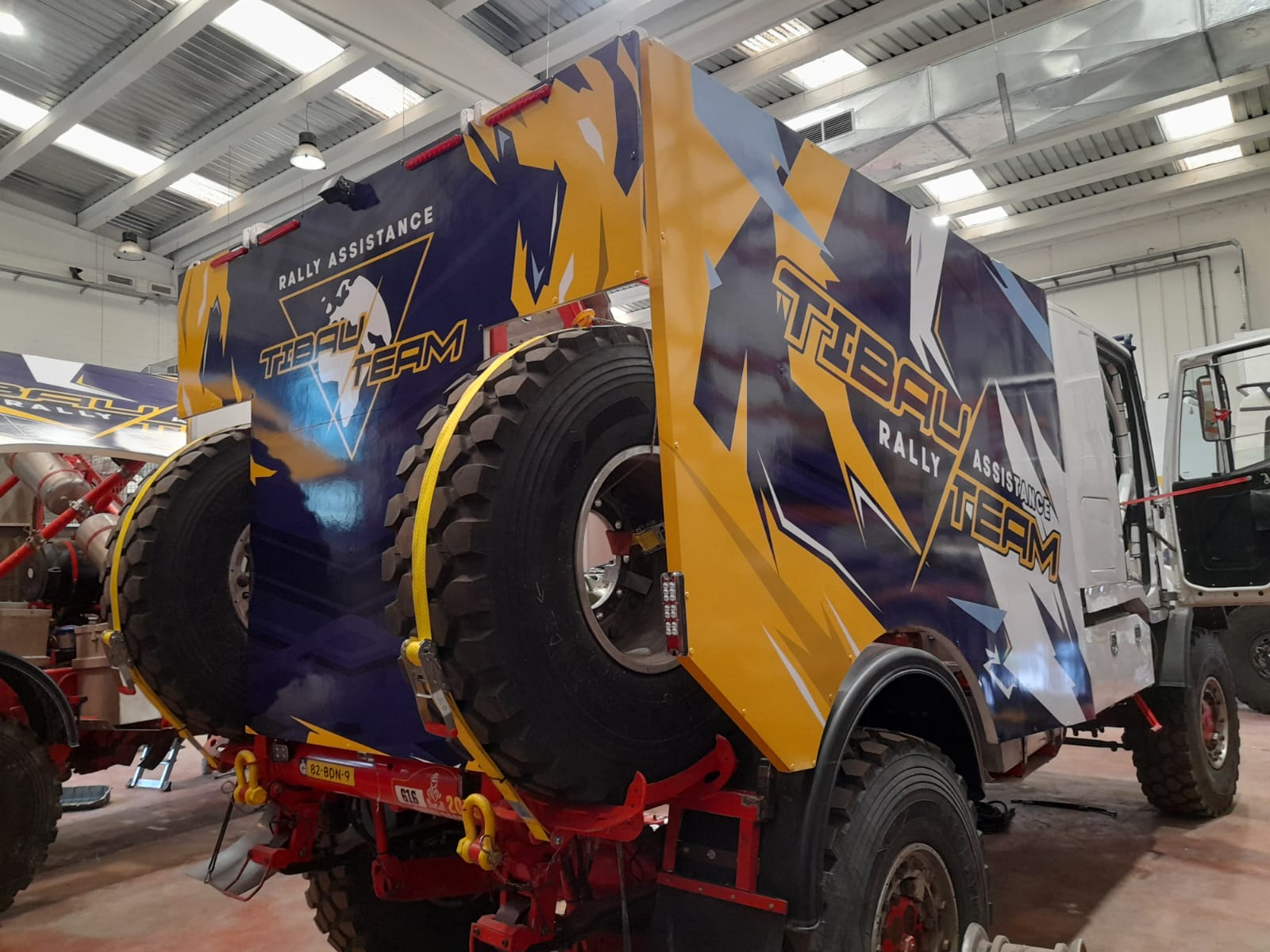
At Unical Graphic we have had the privilege of wrapping the trucks of the Tibau Rally Assistance Team for the Dakar 2026, a project that has allowed us to take our experience in vehicle wrapping to the most demanding level in the motor world.
Materials for extreme conditions
In sports signage there is no room for error in the choice of materials. A vinyl that works perfectly on a commercial car can come off after a few kilometers in the Sahara desert.
Professional Cast Vinyl: We exclusively use cast vinyl from brands such as 3M (Series IJ180, IJ380) and Avery Dennison (MPI 1105), which offer maximum formability to conform to curved surfaces, rivets and metal embossing. Its reduced thickness (50-60 microns) and its repositionable adhesive facilitate application on the complex shapes of a competition truck.
UV Protective Laminate: All printed vinyl is protected with a clear laminate that filters out ultraviolet rays and adds mechanical resistance against sand abrasion. The laminate also facilitates post-stage cleaning without damaging the graphics.
High-resistance inks: Next-generation eco-solvent or latex inks offer a molecular bond to vinyl that resists degradation from extreme heat, humidity and chemicals such as fuel or oil.
The process of wrapping a rally truck
Labeling a competition truck is a process that requires millimeter planning and operational flexibility:
1. Design and distribution of sponsors: The first step is to create the design integrating all the sponsor logos according to their sponsorship level (main, secondary, collaborator). Each sponsor has specific size, location and color requirements that must be scrupulously respected.
2. Adaptation to the vehicle: Unlike a production car, a competition truck has irregular shapes, screwed panels, air intakes, grilles and visible mechanical elements. The design is adapted piece by piece, creating individual templates for each panel.
3. Production and printing: Each piece is printed in high resolution (minimum 1440 dpi) and laminated with UV protection. Pieces are cut with cutting plotter for a perfect fit.
4. Workshop installation: The application is carried out directly in the workshop where the vehicles are prepared, adapting to the mechanical preparation times. It is common to work with the truck partially disassembled, which allows access to areas that would later be hidden.
5. Review and touch-ups: After complete assembly of the vehicle, all edges, joints and stress areas are checked to ensure perfect adhesion.
The importance of sponsors in the competition
In the world of rally raid, lettering is not just an aesthetic issue: it is the physical support of the teams' business model. Most private teams finance their participation in the Dakar through sponsors who, in exchange for their investment, gain visibility in the vehicles.
A good sports signage design should:
- Maximize the visibility of each sponsor according to their level of investment
- Maintain visual coherence of the team without looking like a collage of logos
- Comply with the regulations of the organization (numbers, flags, reserved areas)
- Generate media impact in photographs and television broadcasts
In the Tibau Rally Team project for the Dakar 2026, we integrated more than 10 sponsors (SIM Cargo Ibérica, Borrero Gómez, Timedi, Grupo Ferromolins, Locatel, Frotalia Sur, Strong Forms, Grupo Alumed, among others) in a dynamic and aggressive design that transmits speed and power.
Labeling of competition vehicles vs. commercial: key differences
Although they share basic techniques, sports and commercial signage have fundamental differences:
Durability: Commercial signage should last 5-7 years; The sports one must withstand extreme conditions but for a shorter period (the duration of the competition).
Application: In commercial signage, work is done on standard vehicles with a climate-controlled cabin; In sports, modified vehicles are worked on, often disassembled, in mechanical workshops.
Design: Commercial design prioritizes the readability of information (telephone, website, services); The sports team prioritizes the visual impact, the team's identity and the integration of sponsors.
Materials: Both use premium cast vinyls, but sports wraps require additional protective laminates against sand, mud, and chemicals.
If you are thinking about wrapping your competition vehicle or need to integrate sponsors into your car, motorcycle or rally truck, at Unical Graphic we have the experience and materials to guarantee a professional result at the level of the most demanding competition in the world.