
Signage
Wrapping a company fleet: a practical guide
Wrapping a fleet is not just wrapping lots of vehicles
Wrapping a company fleet means making every vehicle, whatever the model, read as the same brand, and doing it without taking the fleet off the road. The key is three things: a design that adapts to each body shape, templates for each model so every unit comes out identical, and planning in batches.
With one or two vans, the challenge is the design. With dozens, the challenge becomes repeatability: making sure van number forty comes out exactly like the first. That is what this guide is about. If you are after the price per vehicle, see how much it costs to wrap a van and how much it costs to wrap a car.
First, take stock of the fleet
Before designing anything, be clear about what you are working with:
- Models and versions: a short-wheelbase van is not a long one, and a three-door car is not a five-door.
- Body colours: the design has to work on white, on the corporate colour or on whatever comes from the factory.
- Owned or leased: this decides the type of vinyl.
- Use: urban delivery, field service, sales team or distribution lorry. It changes what information must be read and from how far away.
- Planned additions: if the fleet is going to grow, the system needs to be ready to repeat.
This list tells you how many versions of the design you need and how many templates to prepare.
Brand consistency across different vehicles
Hardly any fleet is uniform. Most mix vans, cars and sometimes lorries. The mistake is stretching the same design over all of them: on one vehicle it looks too small, on another distorted.
What works is defining a common graphic structure (where the logo goes, at what height, what information goes with it) and deriving a version for each vehicle type. Some examples from our own projects:
- For TotalEnergies, the branding had to read the same on Renault Kangoo vans and on compact cars, with bodies of different proportions and curves.
- For Grup Vivó, the fleet mixed box lorries, a van and a car, and each unit had to identify the distributor and the brands it carries with the same visual hierarchy.
- For Central Lechera Asturiana, we reframed the countryside photograph for each body format, keeping the horizon line and logo height constant so the lorries and the van read as a set.
The aim is that, when several units are parked together, nobody notices they are different vehicles.
Templates per model: the secret to repeatability
Once the design is approved, a setting-out template is prepared for each model: the position of every element, measured from fixed reference points on the body such as the door seal, the waistline or the door handle. That way the fitter doesn't measure by eye on each vehicle; they apply the template.
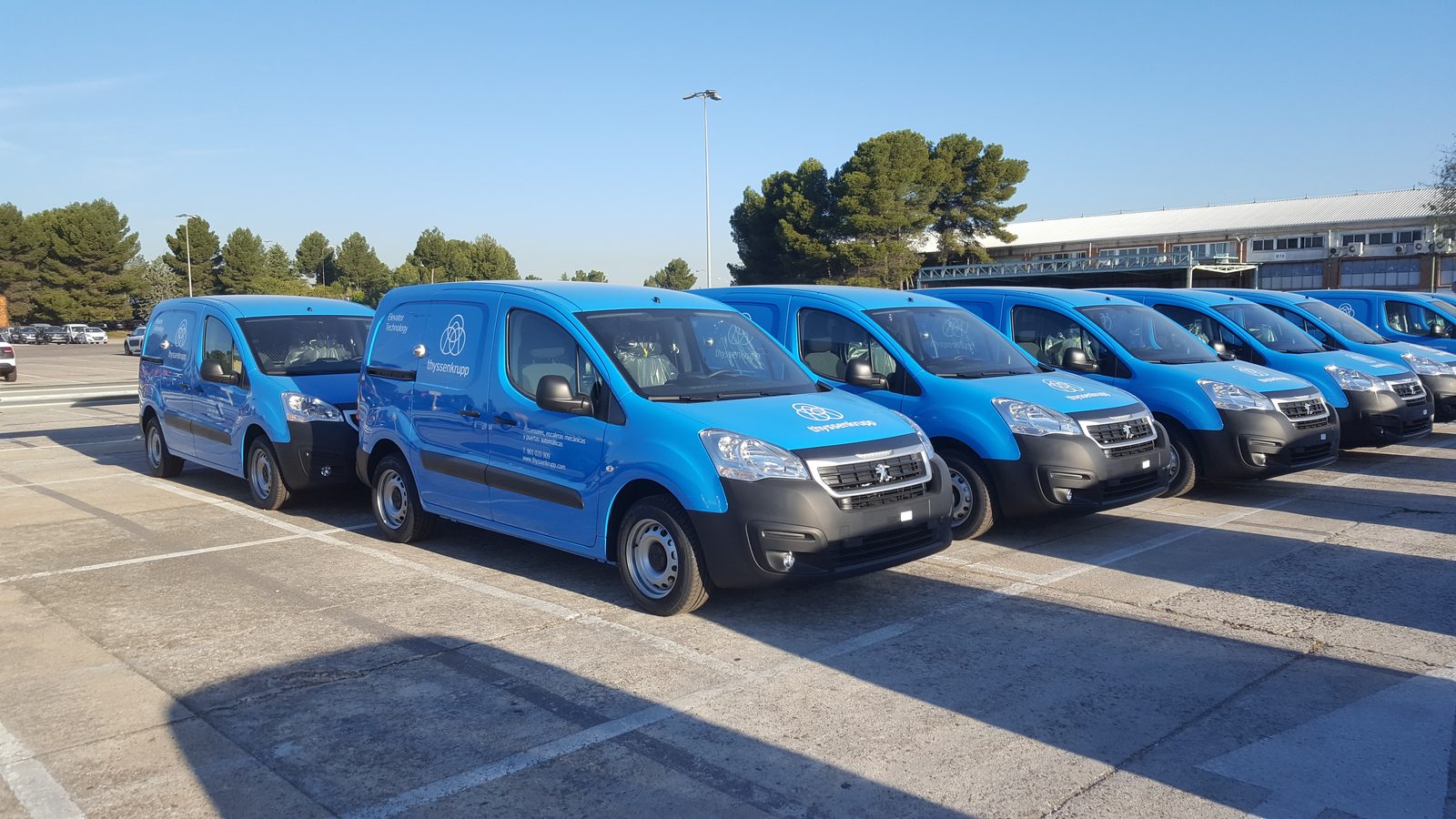
On TK Elevator's fleet of Peugeot Partner vans, dozens of identical units, we set the positions from the door seal and the waistline, and produced the cut vinyl in complete sets numbered per vehicle. Each van came into the workshop with its kit ready. For SGS we worked with two templates, one for the van and one for the car, so the logo sat at the same height across the whole series.
Templates have another advantage: they are kept. When the company adds a new vehicle of the same model, it is wrapped exactly like the others.
Cut vinyl or digital print
The choice depends on the design, not on the number of vehicles:
- Cut vinyl: for logos, lettering and flat single-colour elements. Clean, durable and quick to apply in series. It is what we used for TK Elevator and SGS.
- Laminated digital print: for gradients, photographs or complex graphics. For TotalEnergies we combined both: cut vinyl for the flat elements and print for the brand gradients.
Many fleets mix the two depending on the area of the vehicle. There is more on materials in types of vinyl and their applications.
Leased fleets: vinyl that comes off cleanly
With a lease, the vehicle isn't yours and goes back at the end of the contract, when the paintwork is inspected. So the graphics must be removable without leaving adhesive or marks.
The answer is to use clean-removal vinyl with a laminate, which also protects the paint while the car is in use. For BS AutoRenting's fleet of cars we planned it that way from the start: one common graphic kit for different models, applied with templates and designed to come off without a trace when each car reaches the end of its contract.
Before wrapping, also check what your lease agreement says about vehicle graphics. To understand the differences between materials, see removable or permanent vinyl.
Planning in batches so the fleet keeps running
A fleet off the road is money lost. Wrapping is organised so each vehicle is out of service for as little time as possible:
- In batches: a few vehicles are wrapped at a time while the rest keep working.
- With materials ready: each unit's vinyl kit is produced before the vehicle arrives at the workshop, so the downtime is spent only on application.
- With an agreed schedule: drop-offs are fitted around shifts, routes or the company's quieter periods.
- Before going into service: if the vehicles are new, ideally they are wrapped before they start working.
That is how we work with Makro or TK Elevator, for example: in batches, with each vehicle off the road only briefly. For Ambulàncies Tomàs, whose ambulances cannot be missing from service, installation was done in phases at our workshop, with every unit checked on completion.
Maintenance, replacements and new vehicles
A fleet works hard: frequent washing, sun, scrapes and the odd knock. To keep the image looking good:
- Protective laminate on digital print, which protects the colour against washing and sunlight.
- Careful washing: avoid aiming a pressure washer at the edges of the vinyl.
- Part replacement: if a vehicle is damaged, only the affected section is replaced, using the same file and template, without redoing the whole vehicle.
- Additions and disposals: new vehicles are wrapped using the saved templates, and those that are sold or returned are de-wrapped.
- Rebrands: if the brand is refreshed, the fleet can be updated in batches, just like the first time.
Fleet wrapping with Unical
Since 1994 we have wrapped fleets of every size, from field-service vans to distribution lorries, with design, production and installation handled by our own team. We manufacture in Barcelona and install all over Spain.
If you are comparing suppliers, we explain what to look for in how to choose a vehicle wrapping company. And if you already have your fleet in mind, take a look at our fleet wrapping service or request a quote with your list of models and units. You can also call us on +34 937 50 23 04.
Frequently asked questions
Can different models be wrapped to look the same?
Does the whole fleet have to stop to be wrapped?
Can leased vehicles be wrapped?
What happens if a wrapped vehicle gets damaged?
What do you need to quote for a fleet?
Related articles

How much does it cost to wrap a van?
Complete price guide for commercial and delivery van wrapping.Read article
Vehicle marking company in Barcelona: how to choose the best
Practical guide to finding the best vehicle marking company in Barcelona: what to look for, what to ask and how not to make a mistake.Read article
Removable vs Permanent Vinyl: When to Use Each
Clear comparison to choose removable or permanent vinyl adhesive.Read article

Need this service?
Request a no-obligation quote.