Outdoor Advertising
Outdoor advertising formats: which one to choose
How to choose an outdoor advertising format
The right outdoor advertising format depends on where your audience is, how long you need the message up and what you are allowed to install at that location. If you have your own façade, a banner or vinyl is usually the most direct route. If you want a street presence without a façade, you are looking at billboards, street panels or lamp-post banners. If there is a building site, the hoarding and scaffolding become a huge canvas.
Below we go through the most common formats, what each one is for, the materials used and what to bear in mind about permits.
Building banners
This is the most direct format when the building is yours or you have the owner's permission. A tensioned banner covers a large area at a contained cost and can be seen from a distance.
When it fits: openings, seasonal campaigns, gyms, car dealerships, industrial units and any business with a façade visible from a busy road.
What to check:
- Banner type. Solid frontlit is the standard. In windy spots or on large surfaces, mesh banner, which lets air through, is worth considering. We explain it in mesh banner vs solid banner.
- Weight and finish. They affect strength and lifespan: see the details in our banner weight guide.
- Fixing system. Eyelets, tension cables or a frame. A poorly tensioned banner sags and suffers in the wind.
For the Fibra Max gym we produced a façade banner in 510 g frontlit, installed with a steel-cable tensioning system and perimeter eyelets, using an aerial platform to leave it crease-free.
Billboards and construction hoardings
There are two types worth telling apart:
- Advertising billboards (roadside or street): these sites are usually run by media owners. You book the site for a period and the poster or banner is produced to their specifications.
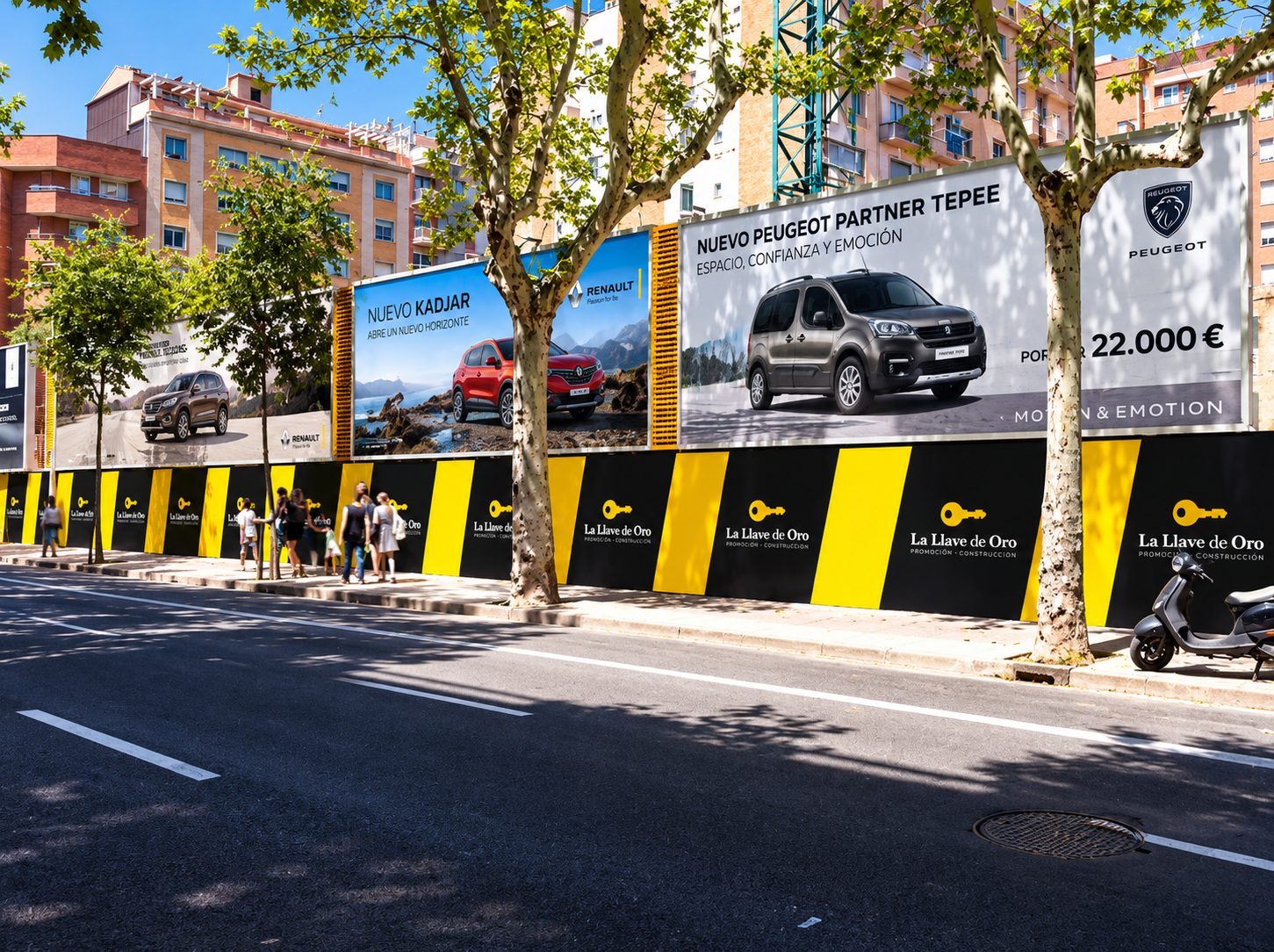
- Construction hoardings: the perimeter fencing around a building site or a shop being refitted. If the site is yours, it is your own canvas, many metres long at street level, for months.
Hoardings are especially useful for developers, builders and shops about to open. For La Llave de Oro we dressed the perimeter hoarding of a building site with a repeating module of black panel, logo and yellow stripe, printed in materials suitable for outdoor use and installed on the public highway while keeping the pavement clear for pedestrians.
On another site, The Black House, we used mesh banner on the most exposed sections to reduce wind load on the fence, and adjusted the panel layout so no join split a logo or a QR code.
Street panels (MUPIs and larger formats)
MUPIs are pedestrian-level street-furniture panels, usually backlit: bus shelters, pavement panels and station panels. Larger formats of the same idea exist in other locations too; the names vary by city and media owner.
When they fit: brand or city-wide campaigns looking for lots of street-level impressions over several weeks.
What to check: the site is sold by the media owner or street-furniture concession holder, who sets the dimensions, material (often paper or a backlit film) and delivery deadlines. The production side is printing on the right material with the right colour so that it looks just as good with the light on as it does in daylight.
Lamp-post banners and flags
Lamp-post banners hang from street lights, poles or façades; flags fly on a flagpole. They are light, visible from several angles and create rhythm when repeated along a street or around a venue.
When they fit: events, trade fairs, sports competitions, venues, car dealerships and city-wide activations.
What to check: they are usually printed on fabric or lightweight banner material, with reinforcement at the fixing points. Wind is the main factor: the material, size and type of pole or bracket must match the exposure. On the public highway, lamp-post banners usually need council authorisation.
For Calvet we dressed the arena of a show-jumping competition with vertical flags on poles with grass-suitable bases, spread out so the name appeared across different planes of the arena.
Large-format vinyl on shop windows and glazing
If you have street-level premises, your shop window is your cheapest billboard. A large-format vinyl can cover the whole glazing or just a band.
Common options:
- Perforated vinyl: the graphic shows from outside while you can still see out from inside. We cover it in detail in perforated vinyl for shop windows.
- Opaque printed vinyl: to cover premises during a refit or create a branded backdrop.
- Cut vinyl: logos, opening hours and text without a background.
- Removable or permanent, depending on the campaign: we compare them in removable vs permanent vinyl.
At Club Natació Terrassa we applied vinyl across the entire glass frontage of the entrance hall with a corporate wave pattern, adapted to each glass module so the whole frontage read as one continuous design.
Scaffold wraps
When a building is being refurbished, the scaffolding can be covered with a printed wrap. It is one of the largest and most visible formats there is, and it often doubles as a tidy way of hiding the works.
What to check:
- Mesh banner almost always, so the wind does not punish the scaffolding.
- Coordination with the builder and with whoever erected the scaffold for the fixings.
- Specific permits: advertising on scaffolding is usually regulated by each local council and, in many cases, limits how much of the surface can carry advertising. Always check before designing.
Outdoor materials and how long they last
Outdoors, materials have to withstand sun, rain, wind and changes in temperature. The most common are:
- Frontlit banner: the basis for façades, billboards and scaffolding. For more detail, see the types of advertising banners.
- Mesh banner: when wind is an issue.
- Vinyl with UV-protective laminate: for glazing, vehicles and panels; the laminate protects the ink from sun and abrasion.
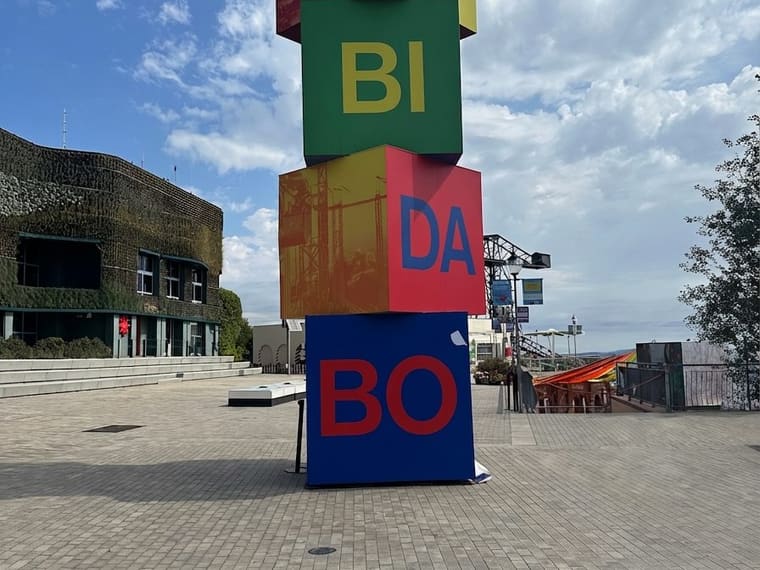
- Rigid composite panels: for signs, cubes and permanent structures.
- Fabrics and lightweight banner: for flags and lamp-post banners.
How long do they last? There is no single figure. It depends on the material, the inks, the orientation (a south-facing façade gets far more sun), the wind and maintenance. As a general rule, a banner is planned for campaigns lasting months, while laminated vinyl or a rigid panel suits longer use. Tell us where it is going and how long you need it, and we will recommend the right material.
Permits: what to bear in mind
Almost all outdoor advertising visible from the public highway is regulated, but the rules depend on each local council, and sometimes on each area within the same city. As a general guide:
- Banners and signs on façades: usually need a licence or notification to the council and, in buildings with several owners, the agreement of the residents' association.
- Scaffolding and hoardings: may need a specific permit for the advertising element, separate from the building licence.
- Lamp-post banners and the public highway: normally need council authorisation.
- Protected areas and historic centres: often have extra restrictions on size, colour or lighting.
- Street panels and commercial billboards: the permit is handled by the media owner.
The safest approach is to check with the council before production or ask us for advice, and we will point you to the procedures that usually apply.
Our outdoor advertising page shows more projects. We manufacture in Barcelona and install throughout Spain. Ask for a quote or call us on +34 937 50 23 04.
Frequently asked questions
Which outdoor advertising format is cheapest?
Do I need permission to put a banner on my façade?
How long does an outdoor banner last?
When should I use mesh banner?
Do you install outside Barcelona?
Related articles
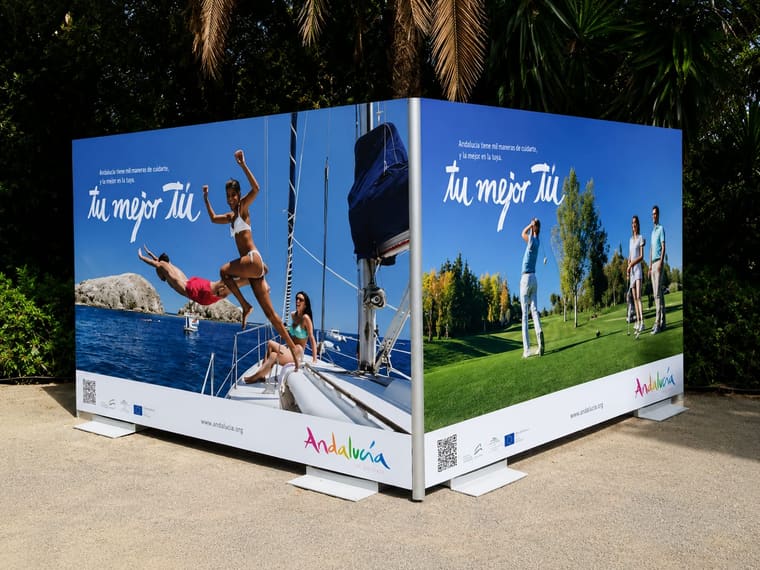
Types of advertising banners and their applications
Practical guide to choosing advertising canvas according to location, duration and visual objective.Read article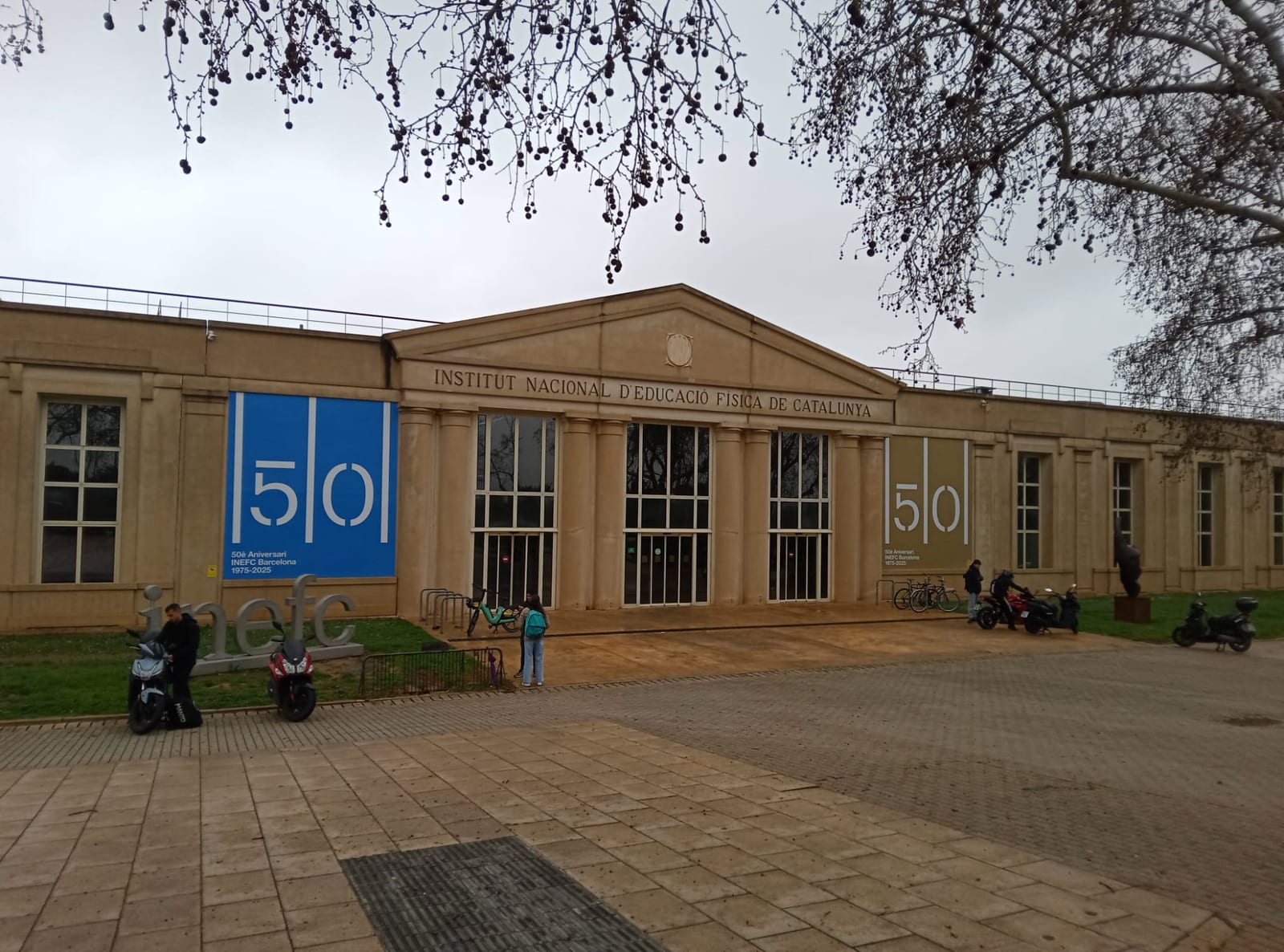
Mesh canvas vs solid canvas: which one do you need?
Practical comparison between mesh canvas and solid canvas to choose with technical criteria.Read article
All about microperforated vinyl for shop windows
Everything you need to know to apply microperforated vinyl in shop windows.Read article

Need this service?
Request a no-obligation quote.