Signs
Permits for a sign on your shop façade: what you need to know
Do you need a permit to put up a sign?
In most cases, yes: installing a sign on a business façade in Spain usually needs some kind of council authorisation. Exactly which procedure (a licence, a prior notification or a responsible declaration) depends on each local council, on the type of sign and on the building.
There is no single rule for the whole of Spain. Each municipality regulates signs and outdoor advertising through its own bylaws, and what one city handles with a simple notice, another treats as a full application with drawings. So the first piece of advice is always the same: check with the council before the sign is made, not afterwards.
In this guide we explain what is usually looked at, what paperwork is commonly requested and how to avoid the most frequent mistakes.
Licence, prior notification or responsible declaration
The names vary by municipality, but broadly you will come across two kinds of procedure:
- Prior authorisation (licence): you submit the application with the paperwork and wait for the council to grant it before installing. This is more common for large, illuminated or projecting signs, or for protected buildings.
- Prior notification or responsible declaration: you tell the council what you are going to install and declare that it complies with the rules. The council may check it afterwards.
Which procedure applies to you, how long it takes and what fees it carries are decided by each council. The reliable source is your municipality's planning or licensing department, or its online portal.
What sign bylaws usually regulate
Bylaws on outdoor advertising or the urban landscape usually set conditions on:
- Location: many restrict signs to the ground floor or to the shop opening, and limit placing them on balconies or upper floors.
- Dimensions: maximum area, letter height or proportion relative to the façade.
- Projection: how far the sign can stick out from the façade, especially for projecting signs, and the minimum height above the pavement.
- Number of signs per shop or per façade.
- Materials and colours, particularly in historic centres.
- Lighting: intensity, type of light, switch-on hours or limits on flashing lights.
The actual figures change from one municipality to another, and sometimes between neighbourhoods in the same city. That is why general numbers make no sense: you need to check the bylaw that applies to your address.
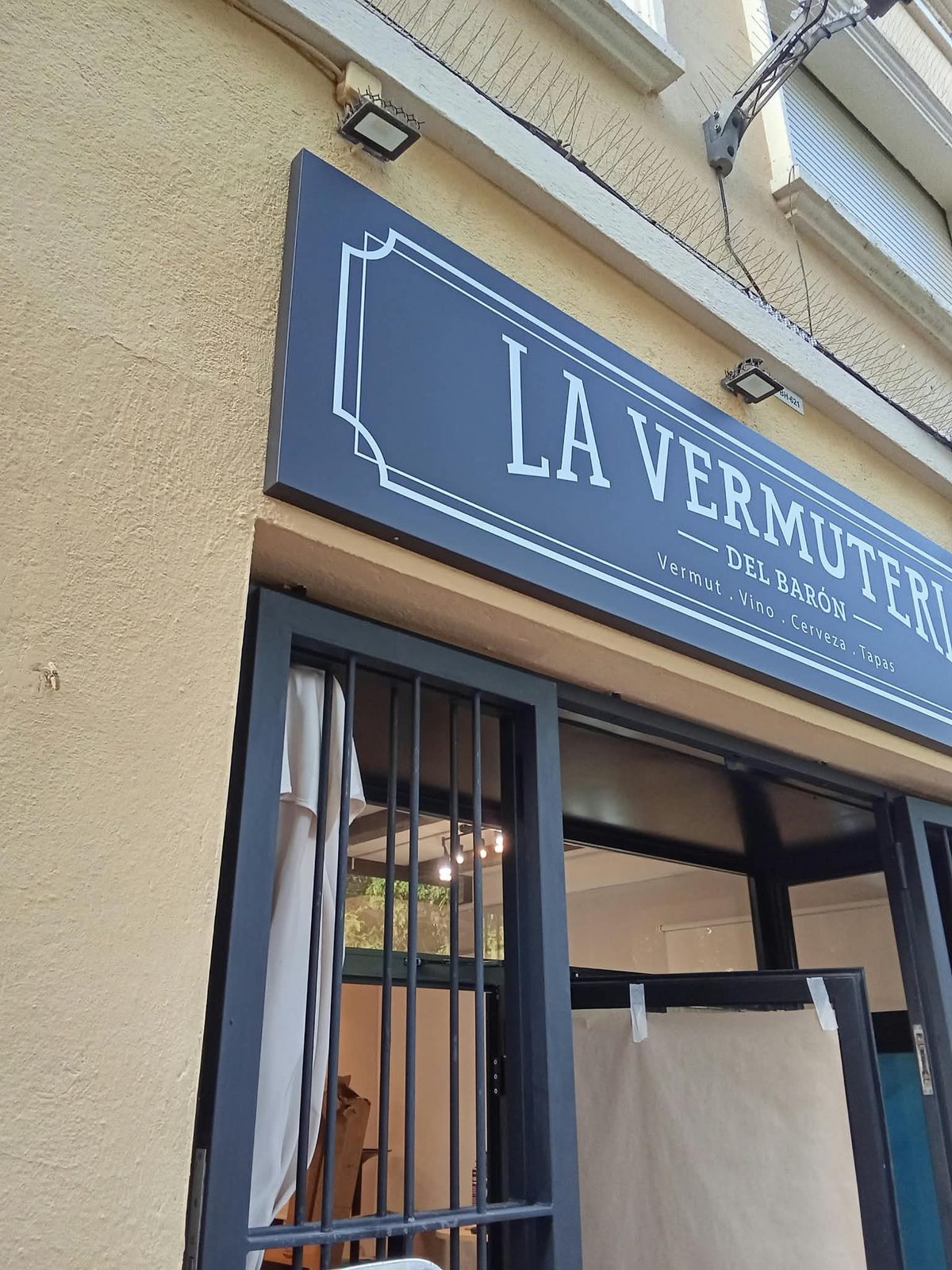
A real example: at La Vermutería del Barón, a bar on the ground floor of a residential building, we sized the projecting sign to the maximum projection allowed and angled the LED floodlights to light the sign without dazzling the neighbours upstairs.
The owners' association
In Spain the façade of a building is usually a common element. Even if you own the premises, putting up a sign may need the approval of the owners' association (comunidad de propietarios), depending on its statutes and the type of work.
Check these points:
- Whether the statutes say anything about shop signs.
- Whether the sign is fixed outside your shop opening or on common areas.
- Whether it is illuminated and could bother residents.
- Whether your lease says anything about signs, if you are a tenant.
Some councils ask for the association's approval as part of the paperwork. Even if they don't, having it in writing avoids disputes.
Protected buildings and historic centres
If the building is listed or sits in a protected area, conditions are usually stricter: materials, colours, typeface, size, lighting and even the fixing method. In these cases a heritage body may be involved as well as the council, and the process tends to take longer.
Here, more than ever, it pays to ask before designing. Individual letters instead of a panel, indirect lighting or a more restrained finish can make the difference between the sign being approved or not.
If the sign is illuminated
An illuminated sign adds two things to consider:
- The lighting itself, which the bylaw may limit in intensity, hours or type, especially in residential areas.
- The electrical installation, which must comply with current electrical regulations and be protected and accessible for maintenance. Some councils ask for technical documentation on the installation.
If you are still choosing, our guide to types of illuminated signs shows the options, and how much an illuminated sign costs explains what drives the price.
What paperwork is usually requested
It varies by municipality, but these documents come up often:
- The council's application form, with details of the holder and the premises.
- A current photo of the façade.
- A mock-up showing the sign in place, to see how it fits the whole.
- A dimensioned drawing or sketch of the sign: measurements, materials, projection from the façade and height above the pavement.
- A location plan of the premises.
- A written description and a quote for the installation.
- The owners' association's approval, where needed.
- Electrical installation details, if the sign is illuminated.
- Proof of payment of the council fees.
On top of that, if installing the sign means occupying the pavement with a lifting platform or a crane, you may need a permit to occupy the public highway for that day.
Mistakes worth avoiding
These are the slip-ups we see most often:
- Making the sign first and asking later. If it doesn't comply with the bylaw, it has to be altered or remade.
- Copying the shop next door. Their sign may pre-date the current bylaw, or may not have a permit.
- Forgetting the owners' association until fitting day.
- Not allowing for processing times in the opening schedule.
- Installing without authorisation. The council can require the sign to be legalised or removed, and there may be penalties.
- Not keeping the paperwork. Keep the authorisation and the documents you submitted to hand in case the council asks for them later.
How Unical helps
We have been making and installing signs since 1994, and we know paperwork holds up a lot of projects. So we advise you from the start:
- We point you to what is usually required and what to check with your council.
- We adapt the design to the bylaw's conditions (size, projection, lighting) before manufacture.
- We give you the technical information on the sign that is usually requested: dimensions, materials and a mock-up on your façade.
- We plan fitting to occupy the pavement for as little time as possible.
We manufacture in Barcelona and install all over Spain. If you are working on your shop's exterior, take a look at our retail signage service or request a quote with photos of your façade and the address of the premises.
Frequently asked questions
Do I need a permit to put a sign on my shop?
How long does it take to get the permit?
Do I need permission from the owners' association?
Do shop window vinyls need a permit too?
What happens if I install a sign without a permit?
Can Unical help with the procedure?
Related articles

How much does an illuminated sign cost? Price and what affects it
The starting price of an illuminated sign and the factors that push it up or down, so you can compare quotes properly.Read article
Types of illuminated signs: light boxes, LED neon, corporeal letters
Guide to choosing illuminated signs according to impact, consumption and type of business.Read article


Need this service?
Request a no-obligation quote.