Retail
Types of POS displays for retail
What types of POS display are there?
Point-of-sale (POS) displays are classified mainly by where they go: floor-standing units, counter displays, gondola ends and totems, plus supporting pieces such as shelf stoppers or floor graphics. Within each format, they are then classified by material: cardboard, rigid materials (foamed PVC, composite, wood, metal) or acrylic.
The choice comes down to four things: how long the campaign runs, how many stores it goes to, how heavy the product is and what image the brand wants to project.
This article is about types and materials. If you are after creative ideas for your next activation, you will find them in POS ideas for retail.
Floor-standing displays
These are units that stand directly on the shop floor, usually in aisles, walkways or near the entrance. They can hold product on trays or shelves, or be purely for communication.
When to use them:
- Launches and promotions where the product needs to get off the shelf.
- Impulse purchases or products that need explaining.
- Activations in hypermarkets where space has been negotiated.
What to bear in mind: product weight dictates the structure. A floor unit with loaded trays needs reinforcement and a stable base. In store they also take knocks from trolleys and general wear, so the finish has to be hard-wearing.
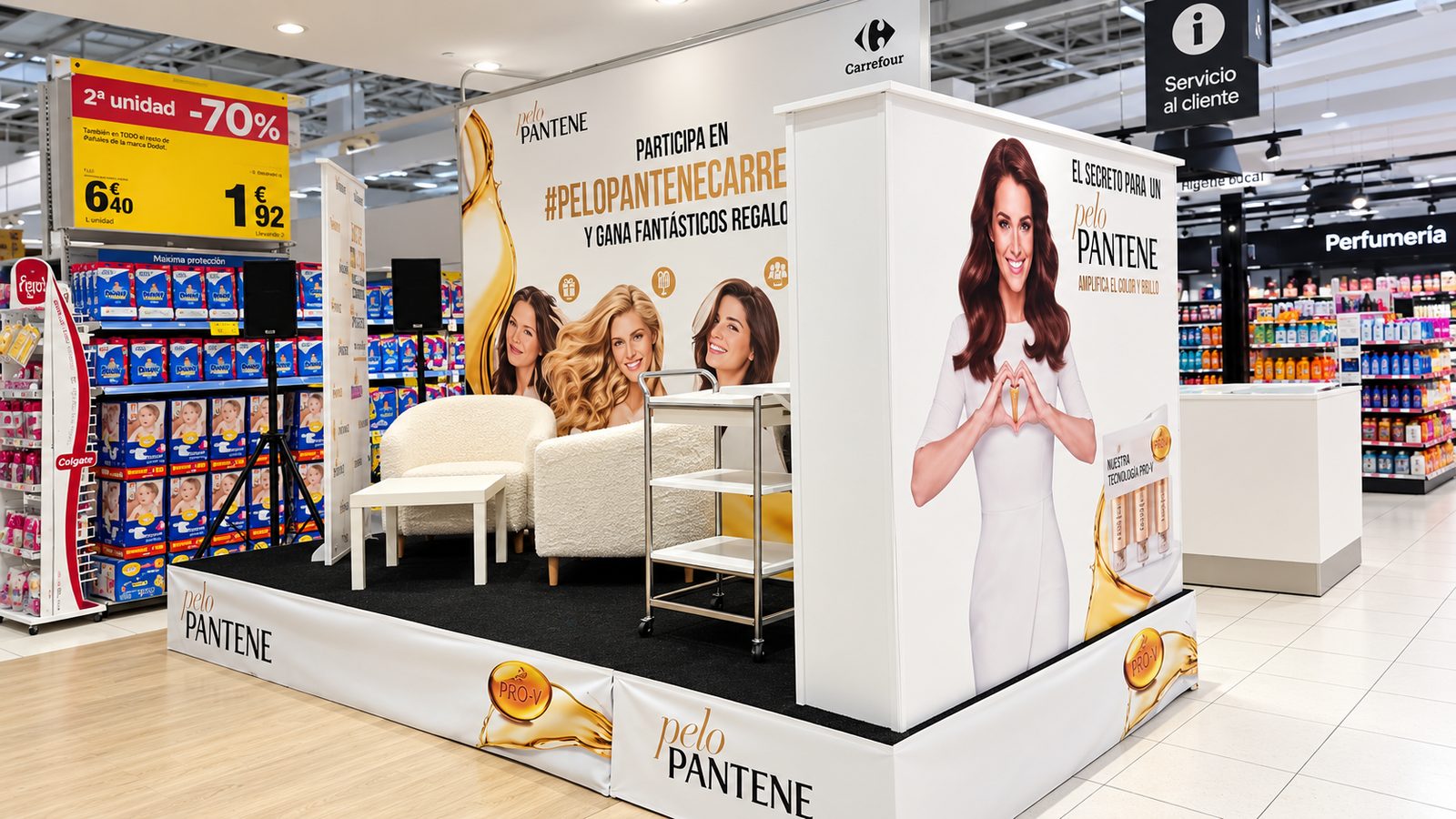
A larger-scale example is the Pantene activation in several Carrefour stores: a modular system of lightweight rigid panel with an internal structure, printed and laminated to resist scuffing, with a weighted base for stability without fixing it to the floor. Everything was produced in series so the look was identical in every store.
Counter displays
These are small pieces that sit on the counter, by the till or on top of a shelf. They take up little space and sit right where customers stop to pay.
When to use them:
- Small impulse-buy products.
- Samples, leaflets or new products you want customers to see at the last moment.
- Pharmacies, perfumeries, opticians and shops with little floor space.
What to bear in mind: because they sit at eye level and very close, people look at them in detail. Print and finish quality show more here than in any other format. Also check the real counter dimensions, as the free space is usually smaller than it looks.
Gondola ends
The gondola end is the end of a shelving run, the part that faces the main aisle. It is one of the most visible spots in a supermarket or hypermarket, which is why it is negotiated with the retailer.
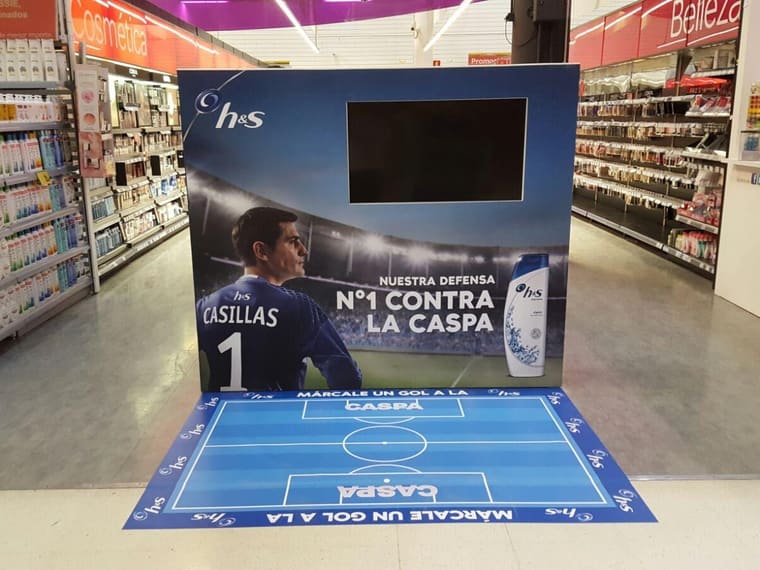
Gondola-end POS can be a complete unit that takes over the whole end, or a dressing of the store's own fixture: header board, side panels, shelf strips and sometimes a floor vinyl in front.
When to use it:
- Seasonal or volume promotions.
- Launches that need maximum visibility for a set period.
What to bear in mind: each retailer has its own dimensions and rules for gondola ends. Before designing, ask for the fixture specifications and the retailer's conditions. If the campaign is rolling out to many stores, assembly needs to be simple and clearly explained.
Totems
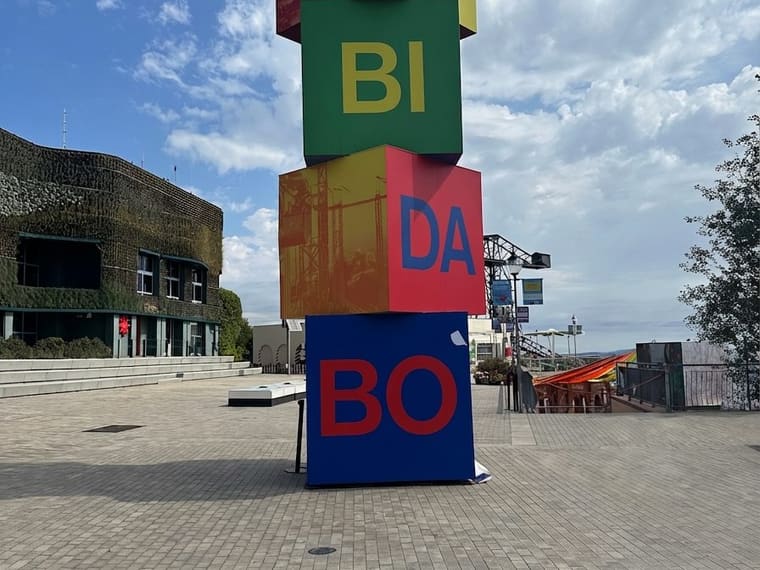
A totem is a tall, narrow freestanding element that works as an eye-catcher or an information point. It can be purely graphic, include a screen or incorporate a small product display.
When to use them:
- Shop entrances, shopping centres, car showrooms or exhibition stands.
- To flag up an area or a promotion from a distance.
- To present a product with video or extra information.
What to bear in mind: being tall and narrow, stability is key. The base needs to be well resolved and, if there is a screen, so does the cabling. For Toyota Professional we built a totem in lacquered board with the screen set flush in a frame that protects its edges, the logo in relief and a wide plinth that keeps it stable without fixings; the cabling runs inside to a single outlet at the back.
Supporting formats: stoppers, hanging signs and floor graphics
Alongside the main formats, there are smaller pieces that usually go with them:
- Shelf stoppers and wobblers: fixed to the shelf and sticking out into the aisle to catch the shopper's eye.
- Hanging signs and ceiling banners: seen from afar and guide people to an area.
- Floor graphics: mark a route or create a branded space in front of the product. They must be anti-slip and suitable for foot traffic.
- Posters and frames: for prices, promotions or messages that change often.
They work better as a kit with a display unit than on their own. For the ASICS Christmas campaign we produced a modular visual merchandising kit adaptable to different store formats, with window vinyls, die-cut cardboard displays, hanging pieces, Forex posters and floor stickers.
Cardboard, rigid or acrylic: which material to choose
The material determines how long a display lasts, its weight, shipping and the image it gives.
Cardboard (microflute and similar)
Light, cost-effective in volume and recyclable. It is die-cut, shipped flat and assembled in store without tools. It is the usual choice for short campaigns and large runs. It copes less well with damp and knocks, so it is not meant for months of heavy use. It can still take premium finishes: the display we made for the Gillette anniversary was die-cut cardboard with soft-touch lamination, gold foil and an integrated product tray.
Rigid materials (foamed PVC, composite, wood, metal)
Tougher and longer-lasting. Used for permanent or semi-permanent displays, for units that carry weight and for pieces that are put up and taken down several times. They weigh more and cost more to ship. If you are weighing them up, see types of rigid printing materials.
Acrylic
Adds transparency, gloss and a premium feel. It is common in perfumery, cosmetics, optics and electronics, for counter displays, leaflet holders and plinths. It scratches easily and needs careful packaging. We compare it with other materials in Forex vs Dibond vs acrylic.
In practice, many displays combine materials: a rigid structure, printed fronts and acrylic parts where the product needs to shine.
How to decide: five questions before asking for a quote
Before talking design, it helps to have clear answers to these:
- How long will it be in store? Weeks point to cardboard; months or years, to rigid materials or acrylic.
- How many units, and for how many stores? Long runs favour die-cut, easy-to-assemble solutions. One-offs allow more bespoke fabrication.
- What product goes on it and how heavy is it? That defines the structure, shelves and base.
- Where exactly will it go? Floor, counter or gondola end, with real dimensions and the store's rules.
- Who will assemble it? If store staff put it up, it must be intuitive. If a dedicated team installs it, more complex pieces are possible.
With those answers, choosing the right format and material is straightforward. Our POS and displays page shows how we work, from production design to manufacture and delivery. If you would like help choosing, ask for a quote or call us on +34 937 50 23 04.
Frequently asked questions
What is the difference between a floor display and a counter display?
When is a cardboard display the right choice?
Is acrylic a good option for POS?
Do I need permission to place POS in a retail chain?
Can you make the same display for many stores?
Related articles
POS ideas for retail
The best point of sale ideas to boost sales in stores and malls.Read article
Types of rigid materials in printing: PVC, aluminum, forex and more
Practical guide to rigid materials in printing for companies and individuals: uses, advantages and real examples.Read article
Differences between forex, dibond and methacrylate: which one to choose?
Clear comparison between Forex, Dibond and methacrylate to choose the correct rigid support for each project.Read article


Need this service?
Request a no-obligation quote.